
The American Battle Monuments Commission maintains 26 military cemeteries in 17 countries. In the weeks before Memorial Day 2026, ceremonies were announced for all of them: wreath-layings, military honours, moments of reflection, partnerships with local dignitaries and veteran organisations. The language of the announcements — “honour the service and sacrifice,” “ensure their legacy continues to be shared with future generations,” “solemn reminder of the cost of freedom” — is the language of commemoration everywhere and always. It is also the language of an institution doing precisely what it was built to do, performing its function with complete fidelity to its mandate, and raising, in that very performance, a question it was not designed to answer: whether the transmission of memory across sufficient temporal distance eventually becomes something other than memory.
The historian Pierre Nora drew a distinction, in his monumental work on French collective memory, between what he called milieux de mémoire — living environments of memory, in which the past is actively present in the practices and relations of a community — and lieux de mémoire — sites of memory, physical or symbolic, constructed precisely because the living connection to the past has been or is being severed. The archive is built when memory dies. The monument is erected when the last witness is gone. The commemorative ceremony is institutionalised in the same historical moment that spontaneous remembrance ceases to be spontaneous.
The Witness Problem
The Second World War ended eighty-one years ago. The last American veterans of that conflict are in their late nineties; the youngest possible survivor would have enlisted at seventeen in 1945. The Korean War ended seventy-three years ago. Vietnam veterans are in their seventies and eighties. The direct chain of personal witness — the person who was there, who can say what it felt like, who carries the knowledge in their body rather than in their reading — is, for the wars that anchor the American commemorative calendar, either gone or in its final years.
This is not a lament. It is a structural observation. Every culture that has maintained significant collective memory across multiple generations has had to grapple with the transition from living memory to transmitted memory — and the evidence across cultures and centuries is that the transition is rarely seamless, that something is lost or transformed in the crossing, and that what survives on the far side is a different kind of thing from what preceded it.
The monument is erected precisely when the last witness leaves. The ceremony is institutionalised in the same moment that spontaneous remembrance ceases to be spontaneous. This is not failure. It is the nature of time.
What Has Crossed the Distance
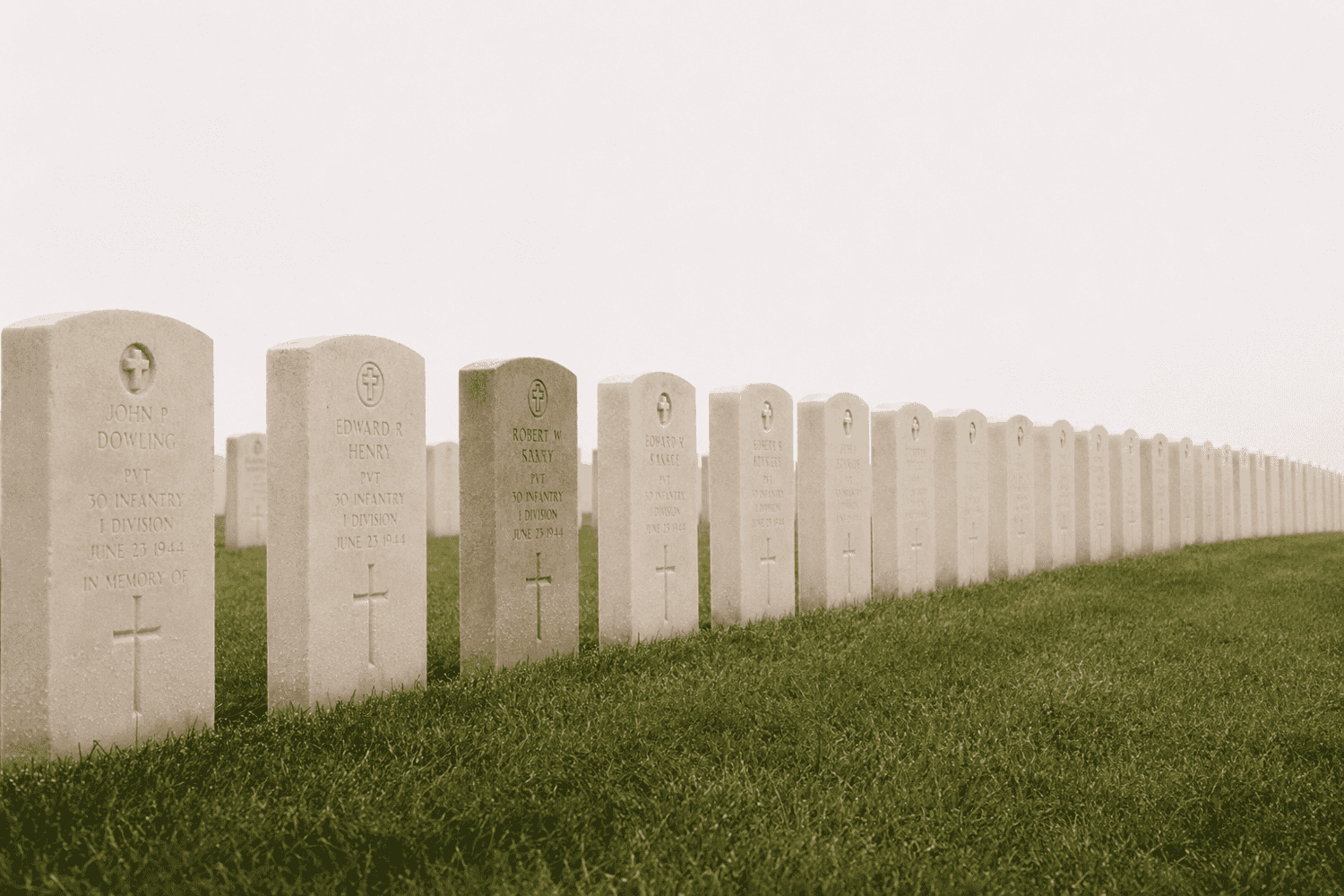
Some things survive the transition well. The physical landscape of sacrifice — the cemeteries at Normandy, the wall in Washington, the fields of Flanders — possesses a capacity to transmit weight that is not entirely dependent on personal connection. There is something in the scale and the specificity of named individuals that operates below the narrative level: the rows of white markers, each one a specific person, produces an effect in the visitor that is not the same as grief but is not merely aesthetic either. The landscape of the dead demands a response that precedes explanation.
Jay Winter, the historian of memory and mourning, has argued that the great wave of memorial construction after the First World War served not primarily as political propaganda — though it served that too — but as a container for grief that had nowhere else to go in societies whose formal mourning practices were inadequate to losses of industrial scale. The memorial was functional before it was symbolic. It gave the bereaved somewhere to direct an emotion that would otherwise have had no object. When the bereaved are gone, the functional layer disappears. What remains is the symbolic layer, which is real but different. It instructs rather than holds. It points to something that cannot quite be carried across by pointing.
The Contested Memorial
The last two decades have added a new dimension to the transmission problem: the memorial itself has become a site of contestation about whose sacrifice counts as national sacrifice and whose story the national narrative should carry. The Confederate monument removals that accelerated after 2020; the debates about whether to rename military installations bearing Confederate names; the ongoing argument about the scope of what Memorial Day commemorates — these are not primarily debates about history. They are debates about the present, conducted in the idiom of the past.
This is, in Nora’s terms, exactly what lieux de mémoire do: they become arenas for contemporary conflict because they are the places where a society’s relationship to its own past is made legible. The monument that was uncontested when the witnesses were alive and the consensus it expressed was maintained by social power becomes contested when both the witnesses and the consensus are gone. The argument about the monument is the argument about who counts — a question that every generation has to answer for itself, in the terms available to it.
What the monument cannot hold is the argument about itself. That argument belongs to the living. The dead have no position in it, which is precisely what makes them available to be recruited for whatever position the living need them to authorise.
What the Evidence from Successful Transmission Shows
The cultures and communities that have maintained consequential collective memory across genuinely long distances — across generations in which no living person knew the events being remembered — share certain architectural features. The memory is embodied in practice, not only in text or monument: it is done annually, physically, communally, in ways that require effort and attention from the rememberer. The memory is attached to specific names and specific places, not only to abstractions like sacrifice or freedom. The transmission includes an honest account of cost, not only of meaning: what was lost, who bore it, under what circumstances, with what consequence. And the memory is renewed rather than merely repeated: each generation is asked not to receive it passively but to reinterpret it in light of its own experience.
The national commemorative infrastructure of a large pluralist democracy does some of these things and struggles with others. The physical specificity of named graves and marked cemeteries is strong. The annual practice, anchored in a federal holiday and maintained by an active veteran population and its families, is sustained. The honest account of cost — the deaths, the wounds, the families hollowed out — is present in the architecture of the cemeteries and the design of memorials like the Vietnam Wall, where the scale of loss is not aestheticised but enumerated. What is harder to sustain is renewal: the capacity of each generation to genuinely interrogate what it owes to the dead rather than merely repeat what it has been told it owes.
That interrogation is uncomfortable. It requires asking which wars were worth the cost, whose sacrifices have been honoured and whose have been erased, what obligations the living actually carry toward the dead beyond the performance of obligation. These are not questions that institutional commemoration handles well. They are also the questions without which the transmission of memory risks becoming what Nora warned it would become without milieux to sustain it: a preservation of the form while the substance quietly empties out.
Today, across the 26 cemeteries on 17 countries, the ceremonies will proceed as designed. Wreaths will be laid. Honours will be rendered. Names will be read. These are not hollow acts. They are the acts of institutions doing what institutions do: maintaining the container in the absence of the content that originally filled it, betting that the container itself has value, and that the generation that eventually fills it again will be glad the container was kept.
That bet has been right often enough in history to justify taking it. It is not a certainty. The difference between a commemoration that transmits weight and one that transmits only form is not in the ceremony but in what the society surrounding the ceremony has done, in the years between ceremonies, to understand what it is commemorating and why.
PRIMARY SOURCES
↗ American Battle Monuments Commission — Memorial Day 2026 Ceremonies