


Life Biosciences received FDA approval in January 2026 for the first Phase 1 human trial of partial epigenetic reprogramming. The science coverage asked whether it will work. The more important questions concern what happens if it does.
In January 2026, Life Biosciences received FDA approval for the first Phase 1 human clinical trial of partial epigenetic reprogramming — a therapy designed to partially reset cellular age without triggering full pluripotency. The trial uses three of the four Yamanaka factors, proteins identified by Nobel laureate Shinya Yamanaka, to reverse cellular ageing markers in patients with glaucoma and non-arteritic anterior ischemic optic neuropathy.
The coverage was, in most respects, predictable: a science story about a breakthrough, framed around the researchers, the funding, and the biology. It reported what the therapy proposes to do and what the early primate data suggests. What the coverage did not ask is more interesting than what it did.
The institutional gap
If partial epigenetic reprogramming works — if cells can be made biologically younger while retaining their differentiated function — the downstream consequences reach far beyond medicine. The legal, actuarial, and social infrastructure of advanced economies is built on an assumption so fundamental it has never required explicit statement: that biological age and chronological age are, for practical purposes, the same thing.
They are not the same thing now, strictly speaking — biological age markers already diverge from chronological age. But the divergence has been small enough, and uncontrollable enough, that institutions have not been required to address it. A therapy that can partially reverse cellular ageing changes that. The divergence becomes large and, in principle, manageable. The institutional architecture has not been built for that.
Four questions no institution is asking
Employment. If a 70-year-old can be returned to the biological profile of a 50-year-old, does their employer have grounds to extend their contract? The UK Equality Act 2010‘s age discrimination provisions were drafted for chronological age. Biological age is not addressed. There is no case law and no regulatory guidance.
Insurance. Life insurance underwriting is built on actuarial tables that are, ultimately, tables of chronological age. The Institute and Faculty of Actuaries has published no framework for biological age in underwriting. If insurers can require genetic testing in some jurisdictions, the question of whether they can require epigenetic age assessments follows with uncomfortable directness.
Pensions. The OECD Pensions at a Glance 2025 addresses retirement age policy exclusively in terms of chronological age. If biological age becomes partially reversible, the fiscal basis of defined-benefit pension systems — which are already under structural pressure — becomes substantially harder to model.
Access. Phase 1 trials are not mass-market products. The initial clinical application of epigenetic reprogramming, if it succeeds, will be expensive, scarce, and unevenly distributed. The question of who receives access to biological age reversal, at what price, and under what insurance or public-health framework is a policy question. No institution with the authority to build that framework is currently working on it.
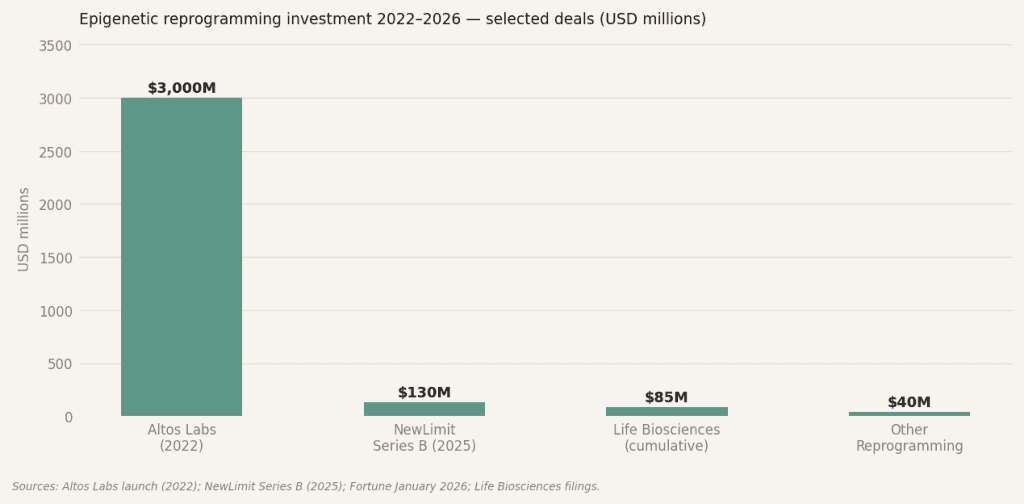
The science may or may not succeed. The first-in-human trial is a Phase 1 safety study. Its results will not resolve the larger biology. What they will do, if the therapy clears its initial safety threshold, is accelerate investment and clinical ambition in a field that is currently running at least a decade ahead of the institutional architecture it will eventually require.
“The regulatory architecture for a world in which biological age can be partially reversed has not been built. No institution with the authority to build it is currently working on it. That is the story. The science is the occasion for telling it.”
SOURCES
— Life Biosciences — FDA Phase 1 approval, January 2026
— Fortune — CEO Jerry McLaughlin interview, Jan 30 2026
— Yamanaka, S. — original four-factor reprogramming paper, Cell, 2006
— OECD Pensions at a Glance 2025
— Institute and Faculty of Actuaries
— UK Equality Act 2010