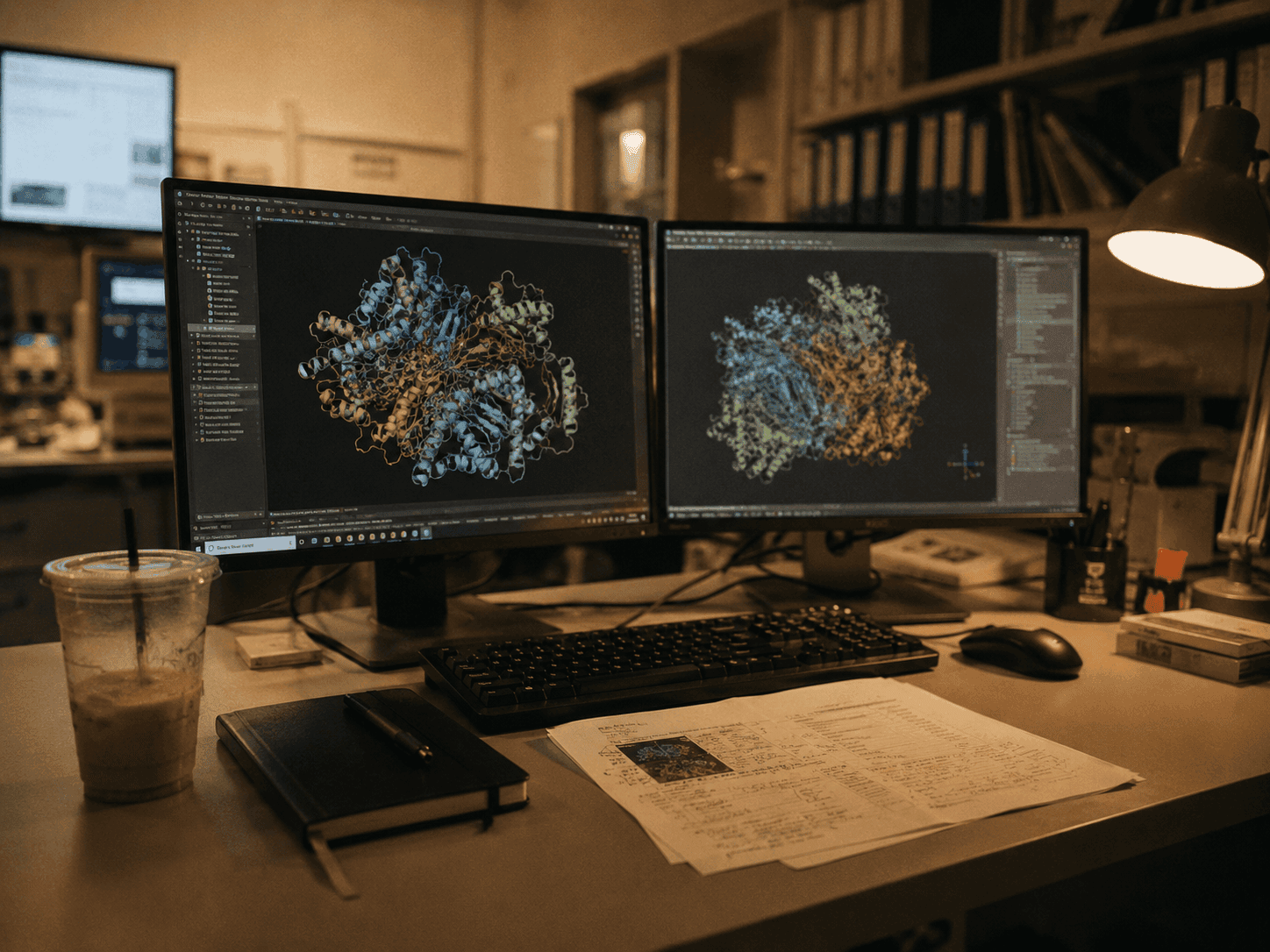

In November 2020, DeepMind announced that its AlphaFold 2 system had achieved near-experimental accuracy in predicting the three-dimensional structure of proteins from their amino acid sequences. The Critical Assessment of protein Structure Prediction competition — the biennial benchmark that has measured progress in the field since 1994 — had seen gradual improvement over 26 years. AlphaFold 2 doubled the previous best score in a single competition cycle. The assessment committee described the result as a solution to one of the most important problems in structural biology.
The claim was not extravagant. Protein structure prediction had been identified as a grand challenge in computational biology for decades because the three-dimensional structure of a protein determines its function, and knowing function is essential to understanding biology and designing drugs. Until AlphaFold, determining protein structure experimentally — primarily through X-ray crystallography or cryo-electron microscopy — was expensive, time-consuming, and often failed. Decades of experimental effort had produced structures for approximately 170,000 proteins. By 2022, the AlphaFold database had predicted structures for approximately 200 million proteins.
Four years on, what has actually changed?
The rate-limiting steps in drug development were never primarily structural prediction. They are toxicology, clinical trial design, and regulatory pathways — none of which AI has materially shortened.
The answer requires distinguishing between what AlphaFold has delivered and what the field had claimed it would enable. AlphaFold has genuinely delivered on its core promise: it has largely solved the protein structure prediction problem, as claimed. The database is real, the predictions are of high quality for most protein classes, and it has eliminated a significant bottleneck in structural biology research. Researchers who previously spent years determining a single structure can now access a predicted structure immediately, focus experimental effort on the cases where prediction is uncertain, and use structural information as a starting point for a range of downstream analyses that were previously bottlenecked by the scarcity of structural data.
What AlphaFold has not delivered, and what was implicitly promised in the more enthusiastic coverage, is an acceleration of the drug development pipeline at the scale anticipated. The gap between a protein structure and a drug is large, and the rate-limiting steps in drug development were never primarily structural prediction.
The drug discovery process, simplified: identify a molecular target relevant to a disease; find a small molecule or biological agent that modulates that target; demonstrate in cellular and animal models that the modulation produces the desired effect; demonstrate in humans that the agent is safe and well-tolerated; demonstrate in clinical trials that it produces clinical benefit. AlphaFold addresses the first step at speed. It does not address steps two through five, which are where the time, cost, and failure rate are concentrated.
A 2024 analysis by the Boston Consulting Group estimated that the typical drug development timeline from target identification to first clinical trial was approximately four to six years before AlphaFold and has shortened by roughly six to twelve months in programmes where AlphaFold has been applied. This is a real improvement. It is not the step-change that the announcement framing implied.
AlphaFold 3, released in 2024, extended the system to protein-ligand and protein-nucleic acid interactions, directly relevant to drug discovery. Benchmark performance was impressive. Early reports from pharmaceutical company research programmes applying AlphaFold 3 to active drug discovery projects suggest that improvement in hit rates is real but modest — consistent with a useful tool that accelerates part of the process, not a fundamental change in the success rate of drug development.
None of this diminishes what AlphaFold has actually achieved. The democratisation of structural information — the fact that a researcher anywhere with an internet connection can access predicted structures for any known protein — is a genuine and durable contribution to biology. The tool has enabled research that would not otherwise have been possible, and some of that research will, in time, produce clinical benefit.
The lesson from AlphaFold is not that AI cannot contribute to medicine. It is that the step-function claims made at announcement — the implication that a breakthrough in one bottleneck dissolves the others — rarely survive contact with the full complexity of what they were expected to simplify.