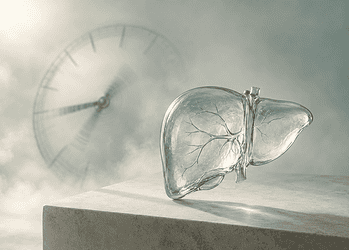


The human body runs on approximately twenty-four-hour cycles. Sleep and waking, cortisol secretion, insulin sensitivity, immune activation, DNA repair, cell division — all of these processes are temporally regulated by a molecular clockwork that operates in almost every cell in the body simultaneously. The master pacemaker sits in a region of the hypothalamus called the suprachiasmatic nucleus, approximately 20,000 neurons that respond to light signals from the retina and synchronise the peripheral clocks in organs and tissues throughout the body. The molecular mechanism — the CLOCK-BMAL1 feedback loop, involving a set of genes called Period, Cryptochrome, and others — was awarded the Nobel Prize in Physiology or Medicine in 2017.
What is now accumulating in the research literature is a specific and well-evidenced connection between disruption of this clockwork and accelerated biological ageing.
The epidemiological signal has been visible for decades. Shift workers — people whose working hours require them to be awake during the body’s biological night, with light exposure and food intake misaligned from their circadian rhythms — show a consistent pattern of elevated health risk. A 2024 meta-analysis published in JAMA Internal Medicine, synthesising data from 24 prospective cohort studies involving over 2.5 million participants, found that shift workers had a 17% higher all-cause mortality risk, a 22% higher cardiovascular disease risk, and a 19% higher risk of type 2 diabetes compared to day workers, after adjusting for socioeconomic and lifestyle factors.
The molecular mechanism is not mysterious. CLOCK and BMAL1 regulate not only the timing of sleep but the expression of genes involved in immune function, oxidative stress response, and metabolic regulation.
The molecular mechanisms connecting circadian disruption to these outcomes are being progressively mapped. CLOCK and BMAL1 — the transcription factors that drive the molecular oscillation — regulate not only the timing of sleep but the expression of genes involved in immune function, oxidative stress response, and metabolic regulation. When the clock is misaligned, these downstream processes are correspondingly disrupted. One of the most clinically significant findings is the relationship between circadian disruption and telomere attrition: multiple studies have now found that shift workers show shorter telomeres — the protective end-caps of chromosomes, whose length serves as a proxy for biological age — than matched day-worker controls.
Research by Satchidananda Panda at the Salk Institute has focused on time-restricted eating — the practice of concentrating all caloric intake within a consistent eight-to-ten-hour window aligned with the active phase of the body’s clock — as a mechanism for reinforcing circadian alignment. In mouse studies, time-restricted feeding prevents obesity, metabolic syndrome, and early-onset age-related disease even on high-fat diets. Human trials, including a randomised controlled trial published in the New England Journal of Medicine in 2023, found that time-restricted eating produces improvements in metabolic markers, blood pressure, and inflammatory measures independent of caloric intake.
The relationship between circadian disruption and cognitive ageing is a more recent area of research. Frank Scheer’s laboratory at Harvard Medical School has documented that circadian misalignment — achieved experimentally by shifting subjects’ sleep schedules out of phase with their biological clocks — produces rapid, measurable impairment in cognitive performance, mood regulation, and metabolic function. The effect reverses when alignment is restored.
What the evidence as a whole supports is a specific and falsifiable claim: that circadian alignment is a significant determinant of biological ageing rate, independent of — though interacting with — other known ageing mechanisms. This is not a claim that anyone who sleeps regular hours will reach 100. It is a more modest and more defensible claim: that the molecular clockwork is a serious biological system, that disrupting it has costs, and that the research on those costs is now at a sufficient scale to take seriously.
The wellness media response to this evidence has been predictable: morning sunlight protocols, blue-light blocking glasses, sleep tracking devices. These downstream applications are not wrong in principle, but they have been detached from the underlying evidence in ways that make it difficult to distinguish what has been tested from what has been asserted. The evidence supports attending to sleep timing and consistency. It does not yet support the more specific claims made by many commercial products in this space.