


The productivity case for AI in professional environments has been made emphatically. A 2026 study found the opposite effect for complex, integrative work. Both findings are true. The resolution matters more than either result.
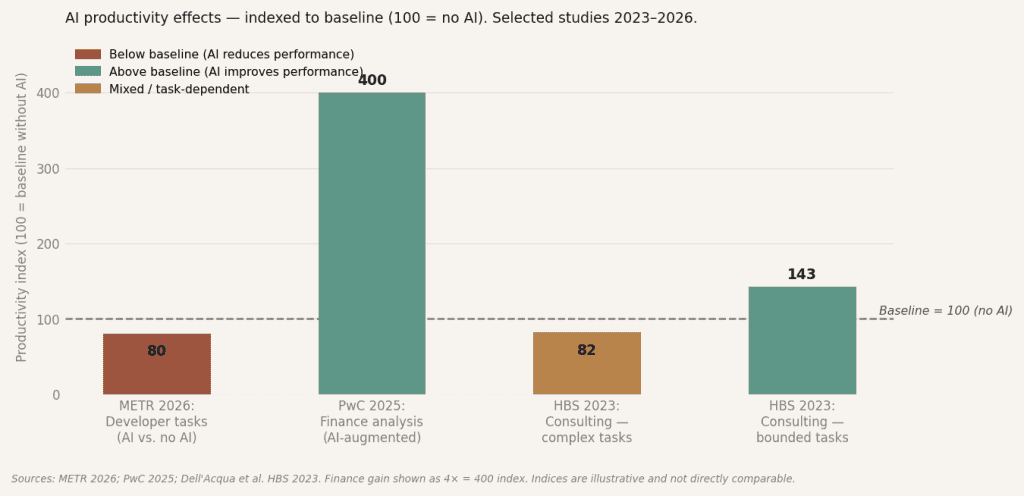
METR — the Model Evaluation and Threat Research nonprofit focused on AI capability assessment — published a 2026 study on AI coding tools and software developer productivity. When experienced developers were given access to AI assistance for real-world tasks, those tasks took 20% longer than without it.
The finding is counterintuitive. It is also methodologically careful. The tasks were drawn from actual developer work, not synthetic benchmarks. The participants were experienced, not novices for whom any tool creates friction. The effect was consistent across the cohort.
Against this: PwC reports fourfold productivity gains in AI-augmented financial analysis roles. Microsoft cites consistent efficiency improvements across Copilot deployments. The Stanford HAI AI Index 2024 documents productivity gains in knowledge work settings across multiple domains.
The resolution is not that one study is right and the other is wrong. It is that AI productivity gains are highly task-specific — and the task specificity is not what the vendor narrative implies.
Decomposable vs. integrative work
AI accelerates the decomposable: drafting, summarising, first-pass analysis, pattern matching within well-defined domains. These are tasks where the value is in the output, where the output can be verified without sustained contextual understanding, and where speed directly translates into productivity.
AI slows or disrupts the integrative: the sustained problem where context, judgment, and accumulated understanding matter more than speed of generation. Complex software engineering falls overwhelmingly into this category. The developer is not primarily producing code — they are holding a mental model of a system and making decisions within it. AI assistance, in this context, introduces friction into that model. The developer must evaluate, verify, and integrate AI-generated code into a context the tool does not share.
The commercial and policy implications
The Harvard Business School field study by Dell’Acqua and colleagues found a related pattern among consultants: AI improved performance on tasks within its capability frontier while degrading performance on tasks that required judgment beyond it. The degradation was larger for high-ability consultants — whose work was most integrative — than for lower-ability ones.
The commercial implication is significant. Organisations adopting AI primarily to reduce headcount are optimising for the wrong variable if the tasks they are automating are integrative rather than decomposable. The workers most at risk of displacement are not, on this evidence, those doing the simplest tasks — those were always automatable. They are experienced professionals whose complex, high-value work is being made slower and harder by tools designed to help them.
Goldman Sachs data shows workers displaced by AI accepting 10–30% pay cuts in new roles. If the METR finding generalises — if AI assistance systematically reduces the productivity of experienced professionals on the work that most defines their value — the displacement dynamic is not an unfortunate side effect of a productivity gain. It is the primary mechanism.
“The task-specificity of AI productivity gains is not a nuance. It is the entire story. An industry that has not made this distinction is not measuring what it thinks it is measuring.”
SOURCES
— METR — AI impact on software developer task performance, 2026
— PwC — AI-augmented financial roles productivity, 2025
— Stanford HAI AI Index 2024
— Dell’Acqua et al. — Navigating the Jagged Technological Frontier, HBS 2023
— McKinsey Global Institute — AI in the Workplace, 2025
— Goldman Sachs — AI worker displacement wage analysis, 2026
— WEF Future of Jobs Report 2025