


The standard economic metrics for assessing the AI transition were not designed for a transition in which the cognitive layer of production is automated rather than augmented. They measure aggregate output. They do not measure who receives it.
Gross domestic product measures the market value of goods and services produced in an economy. It does not measure where the value goes, or who receives it. In previous technological transitions — electrification, computing, the internet — productivity gains eventually translated into wage growth, because human labour remained the primary input to production and workers retained bargaining power over their share of the surplus.
The current AI transition has a structural feature that previous transitions did not. It is automating the cognitive layer of production — analysis, drafting, research, synthesis, judgment in routine contexts — which is precisely the layer through which white-collar workers converted their human capital into wages. When that layer is automated, the surplus flows to capital rather than labour. GDP may rise. Wages for the displaced cohort do not.
The numbers
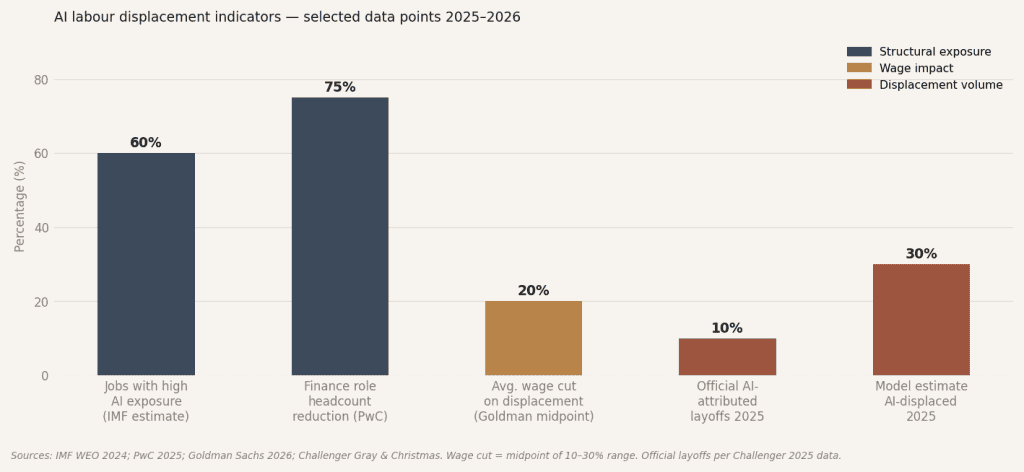
Goldman Sachs data shows workers displaced by AI accepting 10–30% pay cuts in re-employment. PwC data shows AI-augmented finance roles achieving fourfold productivity gains — meaning firms need approximately 75% fewer people to produce the same output. The IMF estimates that 60% of jobs in advanced economies face high AI exposure. The World Economic Forum projects 92 million jobs displaced by 2030, offset by 170 million new roles.
The WEF framing conflates aggregate gains with individual outcomes. A net gain of 78 million jobs is irrelevant to a financial analyst whose role has been restructured and whose salary has been cut by a fifth. The aggregate figures are real and the individual figures are real. Standard economic reporting consistently leads with the aggregate.
The measurement failure
The ghost GDP problem is the divergence between measured economic output and the welfare of the workers who previously produced it. Standard economic metrics do not capture this divergence. Quarterly GDP growth can be positive while the living standards of a significant fraction of the workforce are deteriorating.
The Bureau of Labor Statistics‘s current job classification system does not adequately capture AI-specific displacement. The Congressional Budget Office has no current framework for AI-specific productivity–wage divergence measurement. The data that would allow a precise assessment of the ghost GDP problem does not exist — not because it cannot be collected, but because the institutions with the mandate to collect it have not yet built the frameworks to do so.
The historical parallel is instructive. Lawrence Katz and Alan Krueger’s research on technological displacement in earlier transitions demonstrated that the wage polarisation effects of automation take years to appear clearly in aggregate data. The workers bearing the cost are not in the headline figures. They are in the re-employment statistics, the pay-cut data, and the disability claims that accumulate quietly on the other side of a productivity story.
“The economic frameworks being used to assess the AI transition are not fit for the transition being assessed. They were designed to measure aggregate output. The question this transition poses is distributional. Those are different questions.”
SOURCES
— Goldman Sachs — AI displacement wage analysis, 2026
— IMF World Economic Outlook 2024 — AI job exposure
— WEF Future of Jobs Report 2025
— PwC — AI-augmented financial roles, 2025
— Challenger, Gray and Christmas — 2025–26 layoff data
— Bureau of Labor Statistics— Katz & Krueger — technological displacement and wage polarisation research