
There is a question that confronts every organisation which has existed long enough to watch its founders die: how do you transmit what you are, rather than merely what you do? The tactical functions are the easy part. Any competent successor can learn the procedures. What survives with much less reliability is the institutional character — the set of dispositions, judgements, and implicit standards that give an organisation its particular quality across time.
Most organisations answer this question badly. They confuse succession with replacement: finding someone who resembles the departing leader, rather than someone who can carry the institution’s character into circumstances the previous leader never faced. They concentrate identity in a single person, so that when that person leaves, the identity question becomes urgent and often destabilising. They conflate continuity with stasis, treating any meaningful change as a threat to what the institution is.
Pope Leo XIV is the 267th leader of the Roman Catholic Church, elected to the papacy on May 8, 2025, succeeding Pope Francis and becoming the first American pope in history. The number 267 is worth dwelling on. The Catholic Church has conducted this transition — the transfer of leadership across the entirety of the institution, including its spiritual authority, its governance, its diplomatic relationships, its theological positions, and its claim to represent continuity with the earliest Christian communities — two hundred and sixty-seven times. Not all of those transitions were graceful. Several were violent. A significant number were contested, producing antipopes whose claims competed with those of the elected pontiff. The institution survived them all, and in surviving them produced a record unmatched in the history of organised human endeavour. Encyclopedia Britannica
How is this possible? The answer is not theological — or rather, the theological answer (the protection of the Holy Spirit, the promise of indefectibility) tells you something about how the Church understands its own continuity but nothing about the mechanisms by which that continuity operates. Those mechanisms are of a different order, and they are instructive in a way that extends well beyond any question of faith.
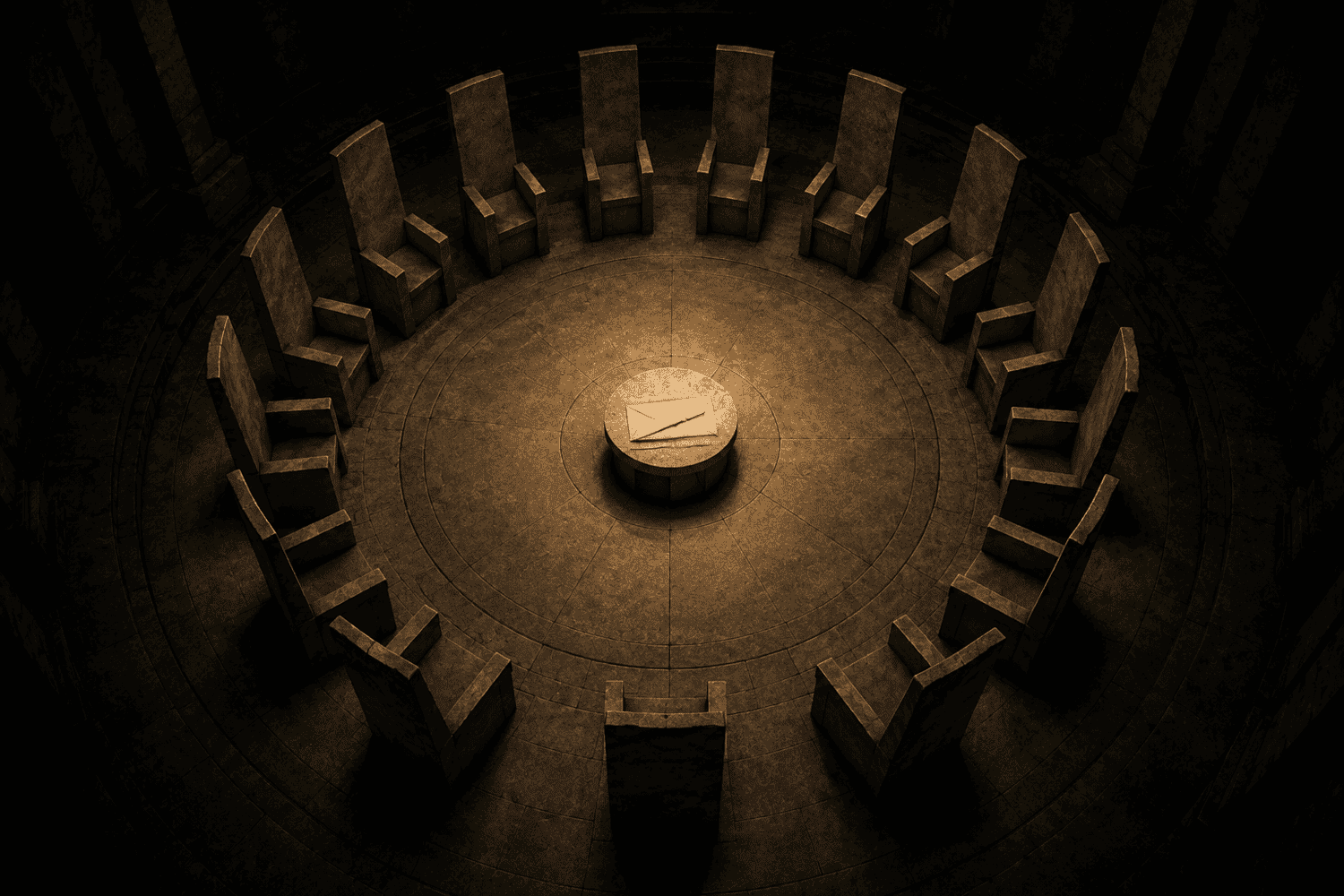
The conclave is the central mechanism. It is a procedure specifically designed to prevent any single individual — any cardinal, any faction, any geopolitical interest — from controlling the outcome of a succession. A new book lifts the lid on how, in May 2025, Pope Leo XIV was elected as the first US-born pope in the Catholic Church’s two-thousand-year history, describing how Cardinal Robert Prevost had quietly garnered support from fellow cardinals as the conclave got underway but remained under the radar of wider attention as a serious candidate. The front-runner faded. The one whose elevation seemed geopolitically problematic — an American, at a moment when American global power was conspicuous and contentious — was elected on the fourth ballot, apparently against the conventional wisdom of Vatican observers who had considered an American pope structurally unlikely precisely because of the country’s dominance in other spheres. CNN
This outcome is not a failure of the mechanism. It is the mechanism working. The conclave is designed to surface candidates who have earned the trust of their peers through decades of institutional service — not candidates who have campaigned, who have positioned themselves, or who have accumulated enough external support to make their selection feel inevitable. The result, in the long run, is a succession process that resists capture by any particular interest while remaining capable of genuine surprise. The surprised, in this case, were the sophisticated observers who thought they understood how it would go.
One can only imagine the gradient of the learning curve that Pope Leo XIV has navigated since his election. Given his ten-day trip to four African countries planned for April, it is intriguing to explore the relationship between Leo and the continent of Africa less than a year into his pontificate. The Africa trip — the first major international journey of the pontificate — is not incidental. It signals a set of institutional priorities: engagement with the parts of the Church that are growing, rather than consolidation in the parts that are declining. This is exactly the kind of strategic adaptation that institutional continuity requires. The Church of the fifteenth century and the Church of the twenty-first century are recognisably the same institution because each generation of leadership has made adaptations that preserved the core while changing what could be changed. The difficulty lies in knowing which is which. America Magazine
The failure mode that destroys institutions across time is not, typically, the dramatic crisis. It is the slow substitution of institutional character by the personality of a single leader — a process so gradual that it only becomes visible when that leader departs and the institution finds itself without a self. The papacy’s answer to this failure mode is the doctrine of papal limits: the Pope has very broad authority within the Church, but that authority is constrained by canon law, by tradition, by the college of cardinals, by the existing structures of the Curia, and by the accumulated theological decisions of his predecessors. No single pope, however extraordinary his personal gifts, can simply remake the institution in his image. Those who have tried — and several have — have generally produced schism, not transformation. The institution survived the schism.
The secular parallel is imperfect but illuminating. The organisations that have lasted longest — certain universities, certain law firms, certain family enterprises — share a version of this architecture: leadership that is broadly empowered but structurally bounded, succession processes that are slow and consultative rather than decisive and personal, and an explicit understanding that the institution’s identity is not located in its current leadership but in something more distributed and harder to name. The Church has had two millennia to work out the details. Most organisations are operating on an institutional timescale of decades.
What Leo XIV represents, at this particular moment, is a succession that appears to have preserved the Church’s reforming trajectory without requiring that trajectory to depend on the person of Francis himself. That is the test of any succession. Not whether the new leader is impressive — Leo XIV’s reputation as a fair, deft administrator and political moderate is well-established — but whether the institution could survive and continue without the particular genius of the previous leadership. The answer, one year in, appears to be yes.
Of the now 267 popes in the history of the Catholic Church, Pope Leo XIV is only the second from the Americas along with his immediate predecessor. The bonds between Leo and Francis run much deeper than geography: Francis called Prevost to the Vatican to serve as leader of the Dicastery for Bishops, the office that selects bishops around the world. The continuity embedded in that appointment — a leader selected partly because he was trusted by his predecessor, who had positioned him to understand the institutional priorities that most needed carrying forward — illustrates exactly how durable institutions manage succession in practice. They do not simply choose the best available person. They choose the best available person who understands what matters to preserve. Biography
The 2,000-year succession problem is not solved. It is managed. The difference is important. An institution that believes it has solved succession tends to stop investing in the mechanisms that make succession survivable. An institution that understands it is permanently managing a difficult problem tends to maintain those mechanisms with care — because it has watched, across sufficient historical time, what happens when they are allowed to degrade.
Sources
- Britannica: Leo XIV — biographical entry, updated May 2026 — britannica.com
- America Magazine: “Pope Leo at Year One,” April 2026 — americamagazine.org
- National Catholic Register: “Why 2026 Will Be the Year of Leo,” December 2025 — ncregister.com
- CNN / O’Connell & Piqué: “The Election of Pope Leo XIV,” March 2026 — cnn.com
- Biography.com: Pope Leo XIV profile —biography.com