
The first decades of automation were primarily an argument about information. What could be made programmable. What could be digitised, modelled, predicted. The machines that took over tasks in this period — from scheduling software to algorithmic trading, from computer-aided design to large language models — were machines without bodies. They existed in the data layer. They were connected to the physical world through sensors and actuators, through screens and keyboards, but they themselves occupied no space. They imposed no weight. They required no corridor.
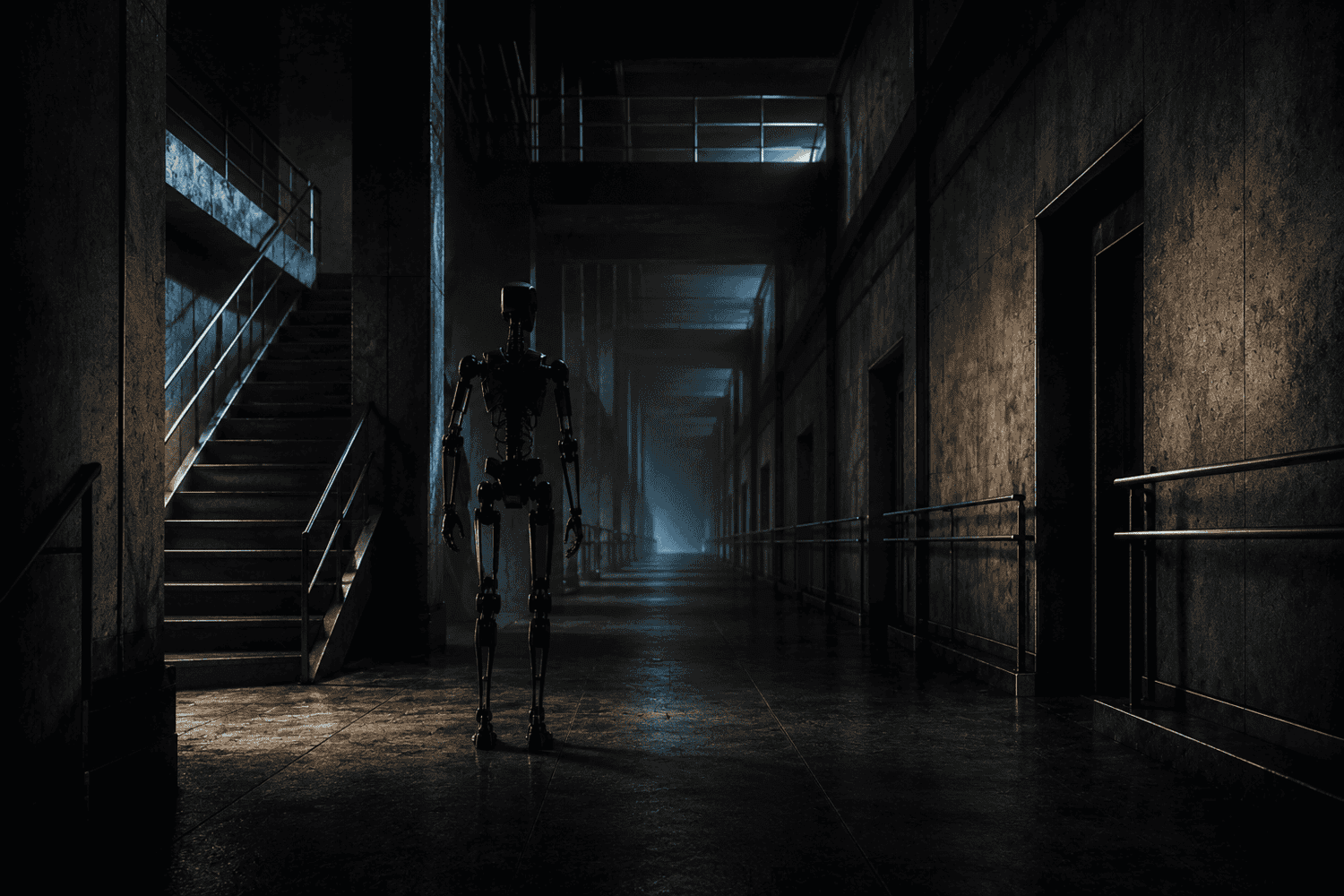
The humanoid robot changes this, and changes it in a way that the existing vocabulary of automation has not adequately prepared for. Boston Dynamics’ product-ready Atlas features 56 degrees of freedom, a 7.5-foot reach, and a lifting capacity of 110 pounds, designed for continuous operation with a 4-hour battery and hot-swappable autonomy. Initial units will be deployed in 2026 at Hyundai’s Metaplant in Georgia. This is not a software upgrade. This is a physical entity, with a humanoid form, capable of navigating the same corridors and operating the same equipment as the human workers alongside whom it will function. The question this raises is not primarily an economic one, though the economic dimensions are real. It is a question about what the human body has been doing in workplaces that the digital layer has not replaced — and whether we understand that well enough to know what we are giving up. Interesting Engineering
Figure 02 supported thirty thousand vehicles at BMW, with over one thousand two hundred and fifty hours and ninety thousand parts handled in real production pilots. Tesla is targeting Optimus production ramp at Fremont for summer 2026. Agility Robotics’ Digit has seven commercial units active at Toyota Canada’s RAV4 manufacturing operation. The scale here matters for how the question is framed. These are not laboratory demonstrations. They are operating deployments in facilities that also employ human workers. The humanoid is not replacing the factory — it is entering the factory. And the factory was designed for human bodies. Humanoid
This design is worth taking seriously. The reason humanoid form factor is strategically compelling for robotics developers is precisely because most human workplaces were built to be navigated by human bodies: stairs, doorways, benches at specific heights, tools with human-hand-sized grips, vehicles with human-proportioned cockpits. A robot designed to general specifications will require workplace modification. A humanoid robot can, in principle, operate in an existing human workplace without physical reconfiguration. This is an enormous practical advantage. It is also, from a systems perspective, a significant philosophical moment: for the first time, the infrastructure built for human presence is being treated as a specification rather than a constraint.
Japan alone faces a projected shortfall of 380,000 care workers by 2025. Pepper and NAO are deployed in Japanese and European care homes for daily companionship, medication reminders, cognitive exercises, and fall detection alerts. Studies published in the International Journal of Social Robotics show elderly residents interacting with humanoid robots report reduced loneliness and improved mood over twelve-week periods. The elder care context is the one where the body-in-the-room question becomes most philosophically charged. In industrial automation, the substitution question is primarily economic: what is cheaper, a human worker or a robot? In care environments, the substitution question is different in kind. What an elderly person in a care facility needs from the people around them is not, in the first instance, task completion. It is presence. The humanoid robot can provide a form of presence — physical proximity, responsive interaction, something that occupies space and responds to questions — but whether it provides the thing that care workers provide when they are present is a different question entirely. Robozaps
Robot-as-a-Service models are gaining traction in elderly care, lowering the barrier to adoption for care facilities that cannot afford upfront capital expenditure on robotics. The RaaS model matters here: it means the economic decision about whether to deploy humanoid robots in care environments will increasingly be made by care facility operators who are facing severe labour shortages and constrained budgets. The philosophical question — what does human presence add — will not be resolved before those economic decisions are made. It rarely is. The question will be answered in practice, in living facilities, in the responses of residents over time, and in the pattern of outcomes that researchers will spend the following decade documenting. Robozaps
The industrial context is more tractable. Current humanoid robots augment rather than replace human workers. They excel at repetitive, physically demanding, or dangerous tasks — freeing humans for complex decision-making and creative work. Companies reporting the highest workforce acceptance emphasise augmentation over replacement. Full labour substitution remains years away due to limitations in dexterity, adaptability, and unstructured problem-solving. Early commercial deployments report ROI payback periods of 18 to 36 months. The 18-to-36 month payback figure is revealing. It suggests that in constrained industrial tasks — specific, repetitive, well-defined physical operations — the economics of humanoid deployment are already viable at current price points. The question of human replacement in those specific tasks is, in an economic sense, already answered. The question of what happens to the workers who performed those tasks is a different, and more difficult, answer. Standard Bots
What the humanoid robot forces into clarity is something that has been true throughout the history of automation but has been possible to obscure: physical presence in work is not just about task completion. It is about accountability, adaptability to unexpected conditions, communication with other humans in the ambient environment, and something that is hard to name but is broadly understood as the quality of attention that a human being brings to a situation they are accountable for with their body. Surgeons who use robotic assistance report changes in the phenomenology of the work — a different relationship to the haptic feedback of tissue, a different sense of the operating field. Factory workers who supervise automated lines report a different kind of vigilance than workers who perform the physical operations themselves. These are not simply matters of preference. They are claims about what changes when the body is removed from direct contact with the work.
The humanoid robot is, in one sense, an answer to this concern: by providing a body-in-the-room, it preserves some of the physical-world interface that pure digital automation removes. But the humanoid body and the human body are not equivalent. The humanoid does not tire, does not feel pain, does not have dependents who need it home by six o’clock, does not have the kind of stake in the outcome of its work that produces the specific quality of human attention. Whether these differences matter for the quality of the work — in surgery, in care, in the precision manufacturing of complex components — is a question that will be answered empirically, over time, in the workplaces where these systems are already operating. The answer will almost certainly be: it depends on the task. The difficult work is knowing which tasks.
Sources
- Boston Dynamics: Atlas product announcement, CES 2026 — bostondynamics.com
- Interesting Engineering: “9 Humanoid Robots at CES 2026” — interestingengineering.com
- Humanoid Press: Key May 2026 Deployments — humanoid.press
- Robozaps: Humanoid Robot Applications Guide, March 2026 — blog.robozaps.com
- Standard Bots: Humanoid Robots in 2026 — standardbots.com