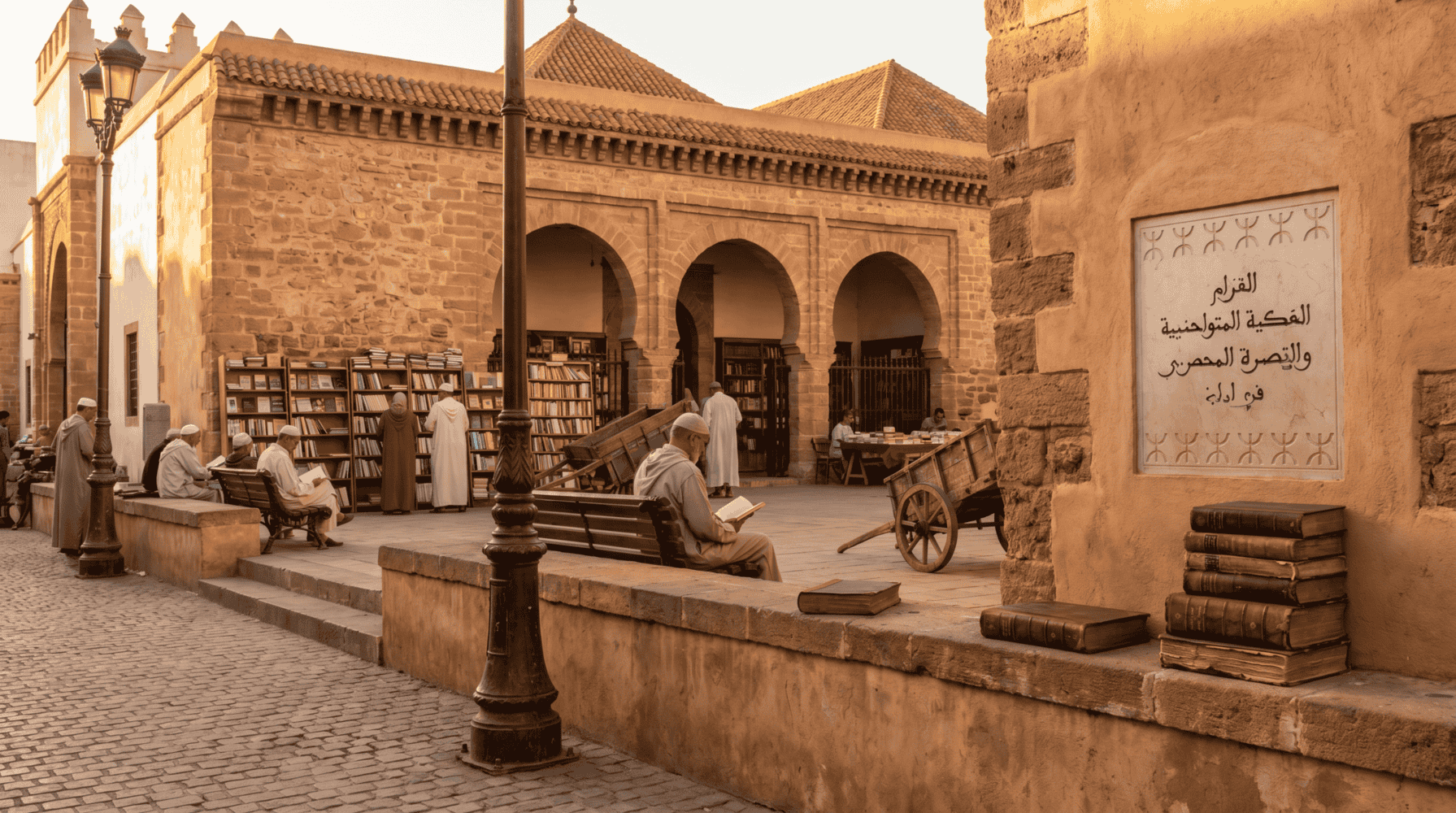

Rabat began its year as UNESCO World Book Capital on 23 April 2026, World Book and Copyright Day.
The title sounds ceremonial. It is not. UNESCO chose the Moroccan capital for 2026 because of its publishing sector, its position as a cultural crossroads, and its commitment to widening access to books and reading. The city has 54 publishing houses, a growing network of bookshops, and one of Africa’s major book fairs.
That matters because books are no longer fighting only for readers. They are fighting for time.
The modern cultural record is crowded, fast, searchable, and unstable. A poem can travel globally in minutes and be forgotten by morning. A political speech can be clipped into fragments and stripped of context. A photograph can be shared so widely that its origin disappears. A book, at its best, does the opposite. It slows a thought down until it can survive contact with another generation.
This is why Rabat’s designation is more interesting than another city branding exercise. A World Book Capital is not only a place that celebrates literature. It is a place temporarily asked to prove that reading belongs in public life: in schools, libraries, streets, bookshops, homes, and civic memory.
VeyrZest’s Culture territory treats culture as the long-duration structures humans build to hold meaning: language, institutions, archives, craft, art, and inherited forms. It is not interested in trends or entertainment cycles. It asks what carries value across time. Rabat’s book year belongs precisely there.
The question is not whether books are loved. Many cultures praise books. The question is whether books are supported.
That distinction is often avoided. Public leaders like the symbolism of reading. It photographs well. Children holding books, authors at podiums, banners over historic streets: the image is easy. The work behind the image is harder. Publishing requires printers, translators, editors, distributors, libraries, copyright structures, teachers, and readers who can afford time as well as paper.
Rabat has a particular claim here. Morocco sits between Arabic, Amazigh, French, Spanish, and wider African and Mediterranean literary worlds. Books in that context are not only cultural objects. They are bridges between languages, classes, histories, and political inheritances. A serious book culture does not flatten those differences. It gives them a place to remain visible.
That is what makes books more durable than content. Content circulates. Books accumulate. Content is judged by reach. Books are judged, eventually, by whether they can still be read when the noise around them has gone.
The recent news around libraries makes Rabat’s year feel less ceremonial and more urgent. In October 2023, the British Library suffered a major cyber-attack that disrupted its services. The institution has been rebuilding systems ever since, including the digital infrastructure that supports access to its national collection.
The lesson was blunt. Even the world’s great memory institutions can be made fragile. A catalogue, archive, or digital repository is not simply a convenience. It is the map by which a society finds its own record. When that map fails, knowledge does not vanish entirely, but it becomes harder to reach, harder to verify, and easier to distort.
This is the real cultural problem of the present: not that memory has disappeared, but that it has become easier to detach from its source.
Books resist that detachment. Not perfectly. They can be censored, lost, mistranslated, priced out of reach, or trapped inside elite institutions. But they still carry provenance better than most modern cultural forms. A book has an author, publisher, date, edition, language, place, and chain of custody. It arrives with evidence of having come from somewhere.
That sounds simple. It is not.
A society that cannot tell where its words came from becomes vulnerable to every convenient fiction. Its past becomes editable. Its arguments become weightless. Its public memory becomes whatever can be repeated most efficiently.
This is why the library and the bookshop should be understood as civic technologies. They are not quaint survivors from an older media age. They are systems for keeping meaning in circulation without surrendering it completely to speed.
Rabat’s year should be judged by that standard. The measure is not how many events are held between April 2026 and April 2027. The measure is what remains afterwards. More children reading in the languages of their lives. More independent publishers able to survive. More translations moving between Morocco, Africa, Europe, and the Arab world. More libraries with staff, budgets, catalogues, and open doors. More books treated as ordinary public necessities, not luxury goods or cultural decoration.
UNESCO’s World Book Capital programme says the designation is meant to promote books and reading during the year and beyond it. The “beyond” is where the meaning sits. Anyone can stage a year. Fewer cities can build an inheritance.
Rabat has been given a title. The title will pass. Another city will receive it. The banners will come down, the programme will end, and the news cycle will move on.
Books are slower than that. They have to be. Their value begins where publicity stops.
A culture does not endure because it produces more words. It endures because some of those words are kept, taught, argued with, translated, repaired, and placed back into public hands. Rabat’s book year matters only if it strengthens that chain.
The honour is temporary. The responsibility is not.