
In early 2026, a high-profile theft at the Louvre and the subsequent French parliamentary inquiry revealed that only 39% of gallery rooms had CCTV cameras as of 2024, and that auditors had described the pace of security upgrades as wholly inadequate. A separate investigation uncovered a suspected decade-long ticket fraud scheme. Staff had gone on strike over overcrowding and understaffing.
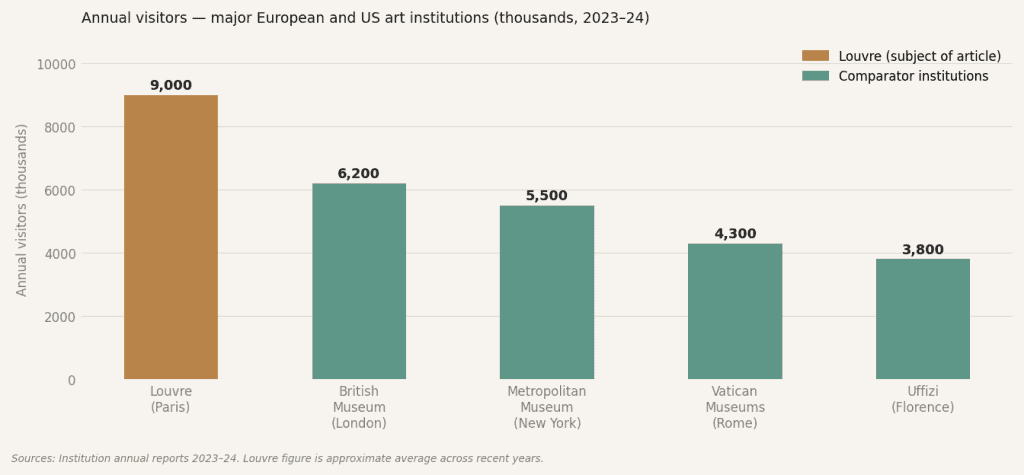
The world’s most visited museum — approximately nine million visitors annually — was shown to be, beneath its surface, institutionally distressed.
The coverage treated this as a crime story, with the security failure and the fraud as its centre. It was not. Or rather, the crime was a symptom of a prior institutional failure that had nothing to do with security and everything to do with the metric by which cultural institutions are now judged: attendance.
The Mona Lisa problem
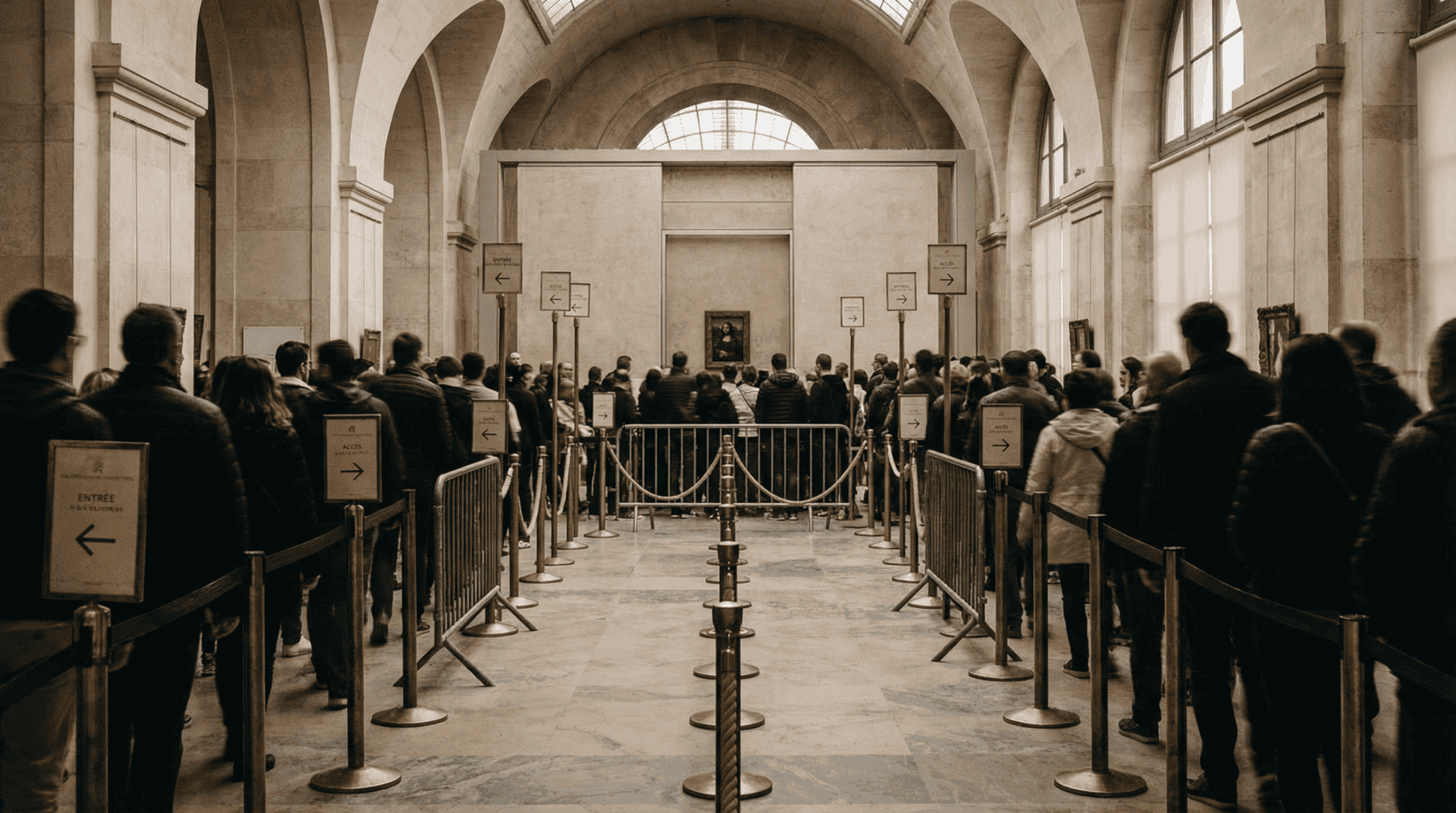
The Mona Lisa hangs in a room where, on peak days, thousands of people file past it in minutes, holding phones above their heads to capture an image of an image they will never look at again. The experience of standing before it is not contemplation. It is crowd management. The painting has not changed. The conditions for experiencing it have been systematically destroyed by the success of the institution that holds it.
This is not a failure of the Louvre’s administration. It is the logical consequence of measuring cultural institutions by visitor numbers. Visitor numbers are the metric that attracts government support, justifies funding, and demonstrates relevance to politicians who must account for public spending. They are also the metric that is quietly destroying the experience of culture that the institutions were built to transmit.
The attendance metric and its consequences
The philosopher John Dewey argued in Art as Experience (1934) that aesthetic experience requires specific conditions — attention, time, the absence of competing demands on perception. The museum, in his account, is not a repository but a space for a particular kind of encounter that cannot be manufactured in a crowded gallery at peak tourist season.
The British Museum, the Metropolitan, and the Uffizi face versions of the same problem. Each has responded with timed entry, crowd management, expanded gift shops, and blockbuster exhibition programming designed to maximise throughput. These are rational institutional responses to the incentive structure they face. They are not compatible with the cultural function the institutions were built to serve.
The Arts Council England grant criteria weight attendance heavily. The National Endowment for the Arts in the United States does similarly. UNESCO has produced frameworks on cultural heritage and overtourism, but has not addressed the structural incentive problem at the funding level, which is where it originates.
“The Louvre is not a security failure. It is the logical endpoint of measuring cultural institutions by the wrong thing. The security cameras were a symptom. The attendance metric is the condition.”
What the alternative looks like
A handful of institutions have begun to experiment with attendance caps, enhanced reservation systems, and time-restricted access to flagship works — accepting lower footfall in exchange for a recovery of what the visit is supposed to produce. These experiments are not yet structurally embedded, and they run directly against the funding incentives that govern most public cultural institutions.
The question the Louvre’s crisis opens is whether attendance is compatible with the cultural function a museum is supposed to serve. The evidence, in April 2026, suggests that at the scale the Louvre has reached, it is not.
SOURCES
— French parliamentary inquiry into Louvre security, 2026
— UNESCO — cultural heritage and overtourism framework
— Arts Council England — grant criteria
— Dewey, J. — Art as Experience, 1934
— James Cuno — Who Owns Antiquity?
— Museum Association (UK) — institutional mission vs. commercial pressure