


The loneliness epidemic is framed as a psychological condition requiring psychological intervention. The evidence suggests it is the predictable consequence of the systematic physical elimination of a specific category of space.
In 1989, urban sociologist Ray Oldenburg published The Great Good Place, in which he named and defined the “third place” — the informal gathering space that is neither home nor work but the social infrastructure of community life. The pub, the coffee shop, the barber, the library, the park bench, the community centre. The place where people of different circumstances encounter each other without agenda, and where the social fabric is, quietly, maintained.
Oldenburg’s argument was that third places were not amenities. They were structural components of functioning communities, and their decline was not a lifestyle inconvenience but a public health and social cohesion problem. He was writing before the smartphone, before remote work normalised the elimination of the commute and the office, and before the cost-of-living crisis made discretionary social spending the first budget line to cut.
The data behind the decline
CAMRA data documents the net loss of thousands of UK pubs over the past fifteen years. CIPFA reports that UK library budgets have been cut by approximately 25% since 2010. The average American now spends between four and seven hours per day on a smartphone. Cigna’s Loneliness Index finds that three in five Americans report that no one truly knows them. The US Surgeon General declared loneliness a public health epidemic in 2023.
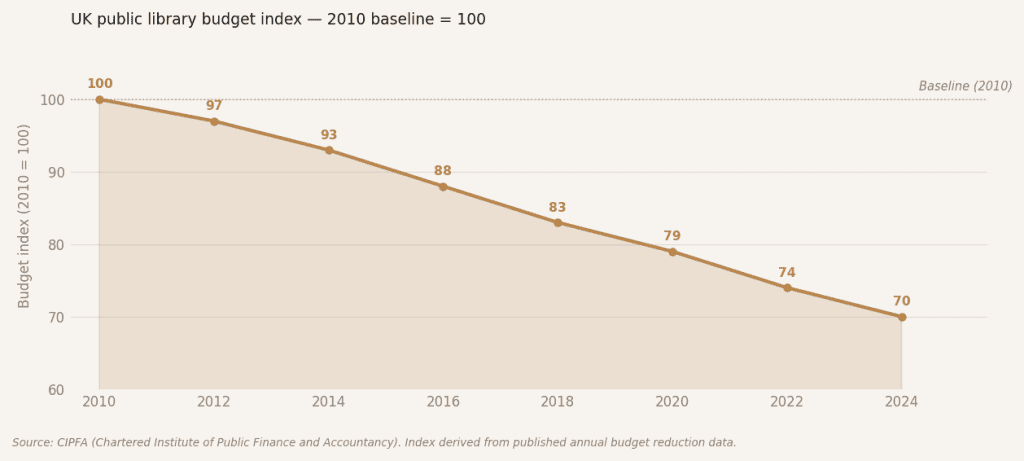
The WHO Commission on Social Connection published its final report in 2025. The American Psychological Association’s Stress in America poll from November 2025 found six in ten adults citing societal division as a significant stressor. A University of Southern California study published in May 2025 documented the specific relationship between financial strain and loneliness — the cost-of-living crisis is not an external factor in the loneliness epidemic. It is one of its primary drivers, operating through the elimination of the discretionary spending that third places depend on.
The structural argument
The dominant policy response to loneliness is therapeutic: mental health apps, social prescribing, community befriending schemes. These interventions are not without value. They are, however, interventions at the individual level for a problem that operates at the infrastructural level.
Robert Putnam’s Bowling Alone (2000) provided the canonical quantitative documentation of third-place decline in the United States. Putnam’s key finding was not that people had become less sociable. It was that the physical and institutional infrastructure for sociability had been dismantled — by suburban sprawl, by the privatisation of leisure, by the economic pressures on small independent businesses that had historically served as community anchors.
Apps cannot replace places. Therapy cannot replace the pub. The loneliness epidemic is the predictable consequence of a specific set of physical, economic, and policy decisions made over the past three decades. The question of what it would take to reverse them is a planning question, an economic question, and a political question. It is not primarily a psychological one.
“Oldenburg was writing in 1989. He was describing a decline already underway. What has changed in the thirty-five years since is not the trajectory — it is the completeness of the effect.”
SOURCES
— Oldenburg, R. — The Great Good Place, Paragon House, 1989
— Putnam, R. — Bowling Alone, Simon & Schuster, 2000
— Cigna Loneliness Index
— US Surgeon General — Social Connection Advisory, 2023
— WHO Commission on Social Connection — final report, 2025
— CAMRA — UK pub closure statistics
— CIPFA — UK library budget data— APA — Stress in America poll, November 2025