


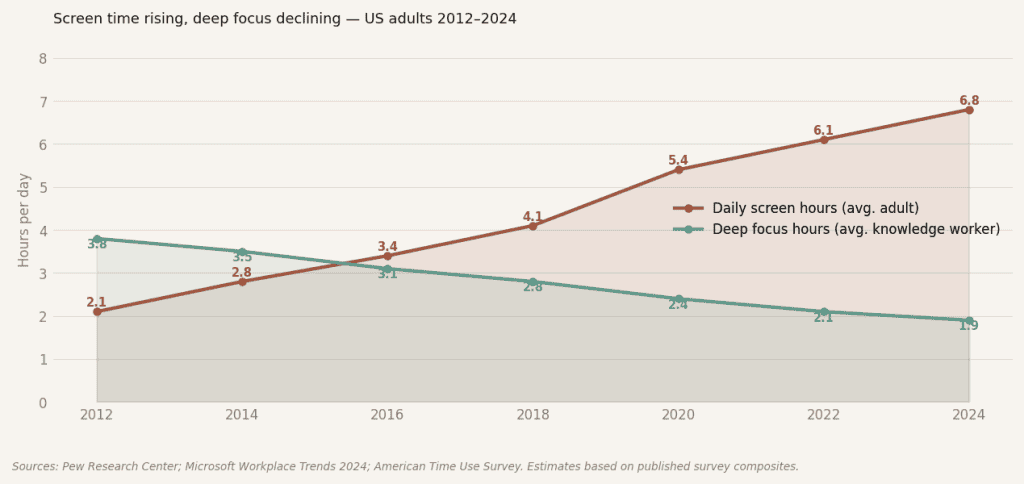
The average American adult now spends between six and seven hours per day on a screen. The average knowledge worker, according to Microsoft’s Workplace Trends research, maintains sustained focus on a single task for less than two hours per working day. These figures are not primarily a productivity story. They are a biology story — and the biology is more concerning than the productivity literature has communicated.
The case against distraction has been made on cognitive grounds: sustained attention is necessary for complex thought; fragmented attention produces fragmented output. This is true but insufficient. The deeper argument is neurobiological. Chronic attentional fragmentation — the state produced by habitual smartphone use, notification exposure, and short-form content consumption — is not merely a productivity inefficiency. It is a modification of the neural architecture that produces attention in the first place.
What chronic distraction does to the brain
Research from the National Institutes of Health and from Stanford’s Department of Neuroscience has documented associations between heavy media multitasking and reduced grey matter density in the anterior cingulate cortex — a region critical for attention regulation, decision-making, and impulse control. These are structural, not merely functional, findings. The cortex is thinner in heavy multitaskers. That is not a metaphor.
The cortisol dimension is underreported. Chronic notification exposure maintains a low-level stress response that keeps cortisol elevated above the levels associated with sustained, productive focus. APA data consistently shows higher self-reported stress in individuals with frequent smartphone checking behaviour.
“The attention economy has externalised its costs onto the biological systems of its users. The industry captures value through engagement. The brain bears the cost in structure and function.”
The sleep connection
Blue-light exposure from screens in the two hours before sleep suppresses melatonin production, delaying sleep onset and compressing REM sleep. REM sleep is the primary phase for the consolidation of episodic memory and the clearance of the metabolic byproducts of neural activity — including amyloid-beta, the protein associated with Alzheimer’s pathology. The glymphatic system — the brain’s waste clearance mechanism — operates primarily during deep sleep and is significantly impaired by sleep fragmentation.
A person who spends two hours on their phone before bed is not merely affecting their next day’s productivity. They are potentially reducing the efficiency of the brain’s nightly cleaning cycle — which, over years and decades, accumulates in ways that may be material to neurological health in later life.
The cultural cost
Serious cultural production — the kind of writing, thinking, art-making, and interpretation that constitutes a civilisation’s intellectual inheritance — requires sustained attention. It cannot be produced in two-minute intervals. It cannot be consumed, meaningfully, in that format either. The shift from long-form to short-form consumption is not merely aesthetic. It is a change in the conditions under which cultural meaning is made and transmitted.
The biological and the cultural costs of the attention economy are the same cost, measured at different scales. The individual bears it in neural architecture and sleep quality. The collective bears it in the quality of thought it can sustain
SOURCES
— NIH — media multitasking and anterior cingulate cortex grey matter
— Microsoft Workplace Trends 2024
— APA — smartphone use and stress data
— Alzheimer’s Society — sleep as modifiable dementia risk factor
— Pew Research Center — American daily screen time data