
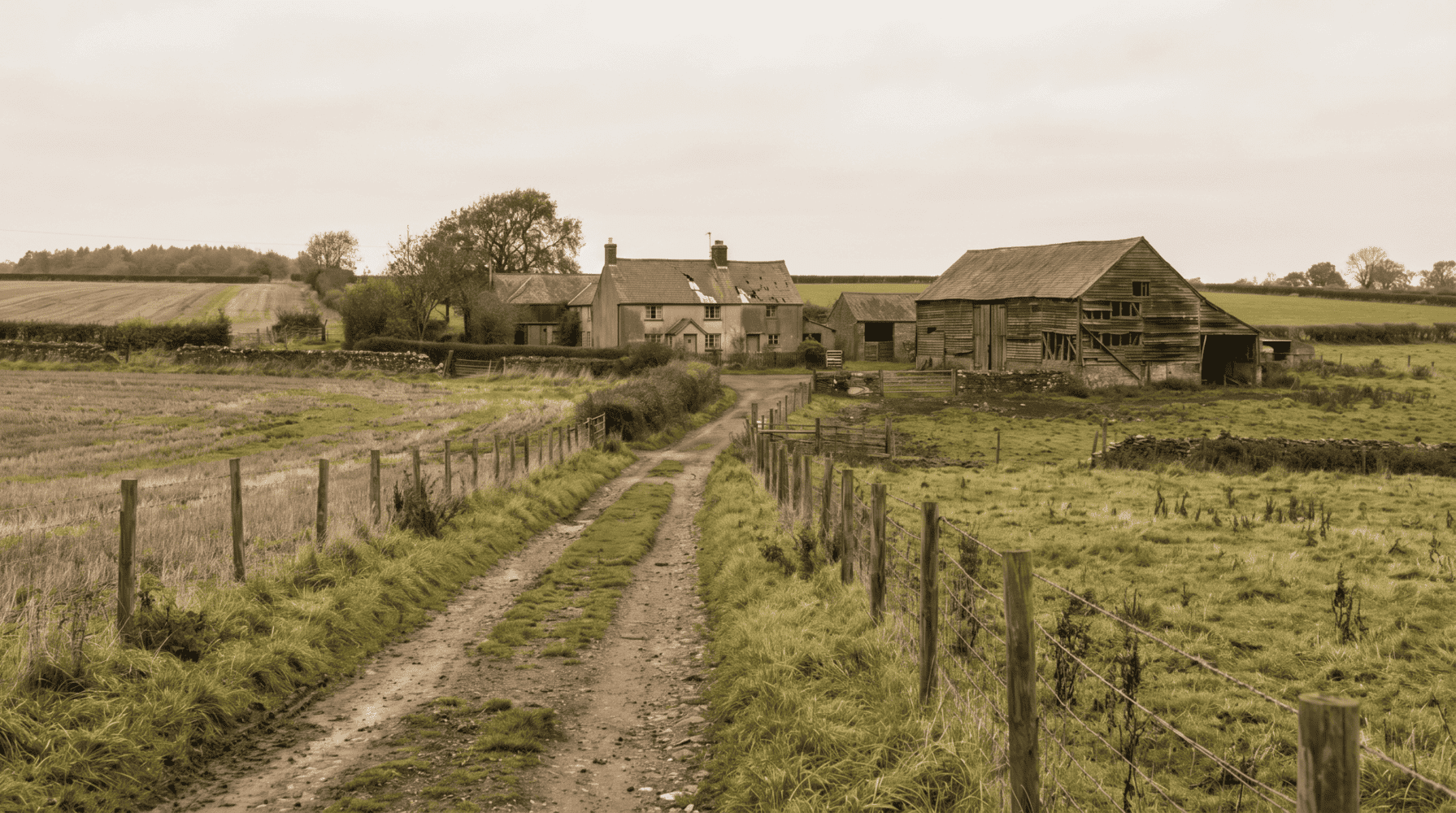

In 2018, the United States had slightly more than two million farms. By early 2026, that number was approximately 1.9 million. The loss of roughly one hundred thousand farms over seven years is not what the phrase “farm crisis” usually invokes. It is not a visible event. It is a rate — about fifteen thousand farms a year in 2025 alone, per the American Farm Bureau Federation — and a rate of this duration is how institutions disappear without anyone deciding they should.
The economists call it consolidation. The word is accurate. It is also, at the cultural level, somewhat misleading.
CONSOLIDATION, PRECISELY DEFINED
A 2026 Farm Journal economist’s summary put the mechanism plainly: consolidation happens because producers have to exit, not because they want to. That matters. The standard defence of consolidation is that it is a market outcome — smaller, less efficient operators are absorbed by larger, more efficient ones; production continues, perhaps at lower cost per unit. Under that framing, nothing of importance is lost, and some gain in aggregate productivity is plausibly achieved.
The framing understates what a farm is. A farm is an operating business. It is also, in the American case, a multi-generational transmission device. The operator on the land in 2026 is, more often than not, the third or fourth generation to work that soil. The knowledge being applied — when to plant, where the field drains poorly, which corners will produce in a dry year, what the previous owner knew about the neighbours — is the accumulated output of three or four working lives. It is not, in any technical sense, written down. It is held in the person working the land, and it moves into the next generation only if the next generation is still there.
A farm consolidation removes the operator. It does not preserve the knowledge. It does not, for the most part, preserve the succession. What succeeds a foreclosed family farm is typically not another family farm; it is either a larger operation that rents or acquires the land, or an institutional holder — a family office, a pension fund, a sovereign wealth allocation, a real-estate-into-agriculture REIT — that leases it to a managed operator. The land continues to produce. What it transmits is a different thing.
WHAT TRANSMISSION LOOKS LIKE WHEN IT WORKS
The philosopher Paul Thompson, writing in The Spirit of the Soil (1995), drew a useful distinction between two kinds of agricultural knowledge. The first is productive knowledge — what produces yield, the kind that shows up in input-output ratios. The second is what he called place knowledge: the accumulated understanding of a specific landscape that allows the productive knowledge to be applied well. Productive knowledge can be taught. Place knowledge can only be transmitted, and only by someone who has it.
A farm that has been held by a family for a century transmits, across that century, a particular relationship to that landscape. When the farm is sold, the land remains. The relationship does not.
Place knowledge is what disappears first when the transmission breaks. A new operator on a familiar landscape is a more productive figure than a local narrative often allows — the land does not, in the short run, punish the newcomer. The punishment arrives slowly, across cycles: in the fields that were known to be wet and are now planted anyway, in the erosion patterns that were being managed and are no longer, in the ditch that needed clearing before every heavy rain and has not been.
The mechanism is easy to describe and difficult to reverse. A farm that has been held by a family for a century transmits, across that century, a particular relationship to that landscape. When the farm is sold, the land remains. The relationship does not.
THE SECOND INSTITUTION, WHICH IS LESS VISIBLE
There is a second institution that depends on the first, and is thinning with it. The American small town — the county seat, the cluster of school, hospital, feed store, church, tavern, and post office that sits at the centre of an agricultural region — exists because there are enough working farms around it to sustain the critical mass. When the farms thin, the town thins.
The rural health statistics are the clearest indicator. Roughly twenty percent of Americans live in rural areas; only nine to ten percent of physicians practise in them. Rural cardiac-disease mortality is about twenty-one percent higher than urban. Rural maternal mortality is approximately twice as high. Closures of rural maternity wards accelerated through 2025. In nine states, at least a quarter of the rural hospitals still offering maternity care had lost money for two consecutive years.
The closures are not independent of the farm thinning. They follow it. A rural hospital loses volume when the surrounding population declines; it loses the ability to attract specialist physicians; its labour and delivery unit becomes unprofitable; it closes the unit; the remaining specialists relocate; the hospital’s strategic case erodes. The sequence is visible in the data. A hospital that closes a maternity ward is downstream from farms that foreclosed over the previous five to ten years.
This is a cultural loss that passes through an economic mechanism. It is not principally about GDP or productivity. It is about a layered infrastructure of rural life — farm, school, hospital, county — that is mutually sustaining and that, once unthreaded, does not, in any modern society, thread itself back together.
WHY THE REPLACEMENT IS NOT THE SAME THING
A 2026 aid package will not rebuild this. The mechanism is too slow to be repaired by a payment cycle. The seventy-eight percent of farmers planning to use government payments to pay down debt rather than reinvest is not, as it is sometimes characterised, a failure of farmer entrepreneurship. It is a rational response to a long-duration margin compression — three consecutive years of negative returns across nearly all row crops, per the Ag Economists’ Monthly Monitor — in which the sensible use of a liquidity injection is to reduce balance-sheet risk, not to expand.
The government payment can stabilise a farm this year. It cannot restore the succession. A farm has succession when the operator’s children are prepared to take it over, which requires the children to have seen farm work as something they can build an adult life around. Three years of negative returns is an education in the opposite direction. The children who concluded in 2023 that the farm was not a future are not going to reverse the conclusion in 2028 because the farm survived by taking on more debt.
Consolidation, as it is currently proceeding, replaces transmission with employment. The farm that is absorbed into a larger operation is farmed, often by the same person who farmed it before, but as an employee rather than a principal. The knowledge may be retained in that person. It is not retained in the institution. When the employee retires, the knowledge leaves. This is a specific kind of loss, and it is the kind the American agricultural economy has been producing, in increasing volume, since the 1980s.
THE DURABLE POINT
The durable cultural question is not whether American agricultural productivity will survive the current crisis — it will, with caveats — but whether American agricultural culture will survive it. The distinction is not decorative. A country that continues to produce corn, wheat, and soybeans but has replaced its operator-owners with employees of institutional landowners is not a country that has lost its farms; it is a country that has lost the institution that happened to produce its farms. The second thing is harder to see than the first. It is also what is harder to rebuild.
The ambition of cultural transmission, in any domain, is the ambition of preserving the thing that took generations to accumulate, so that the next generation is not obliged to start over. On the American farm in 2026, that ambition is being ceded — quietly, by rate rather than by decision — to institutions that are structurally incapable of holding it.
Worth noting: this is not new. It is simply further along than it was five years ago.