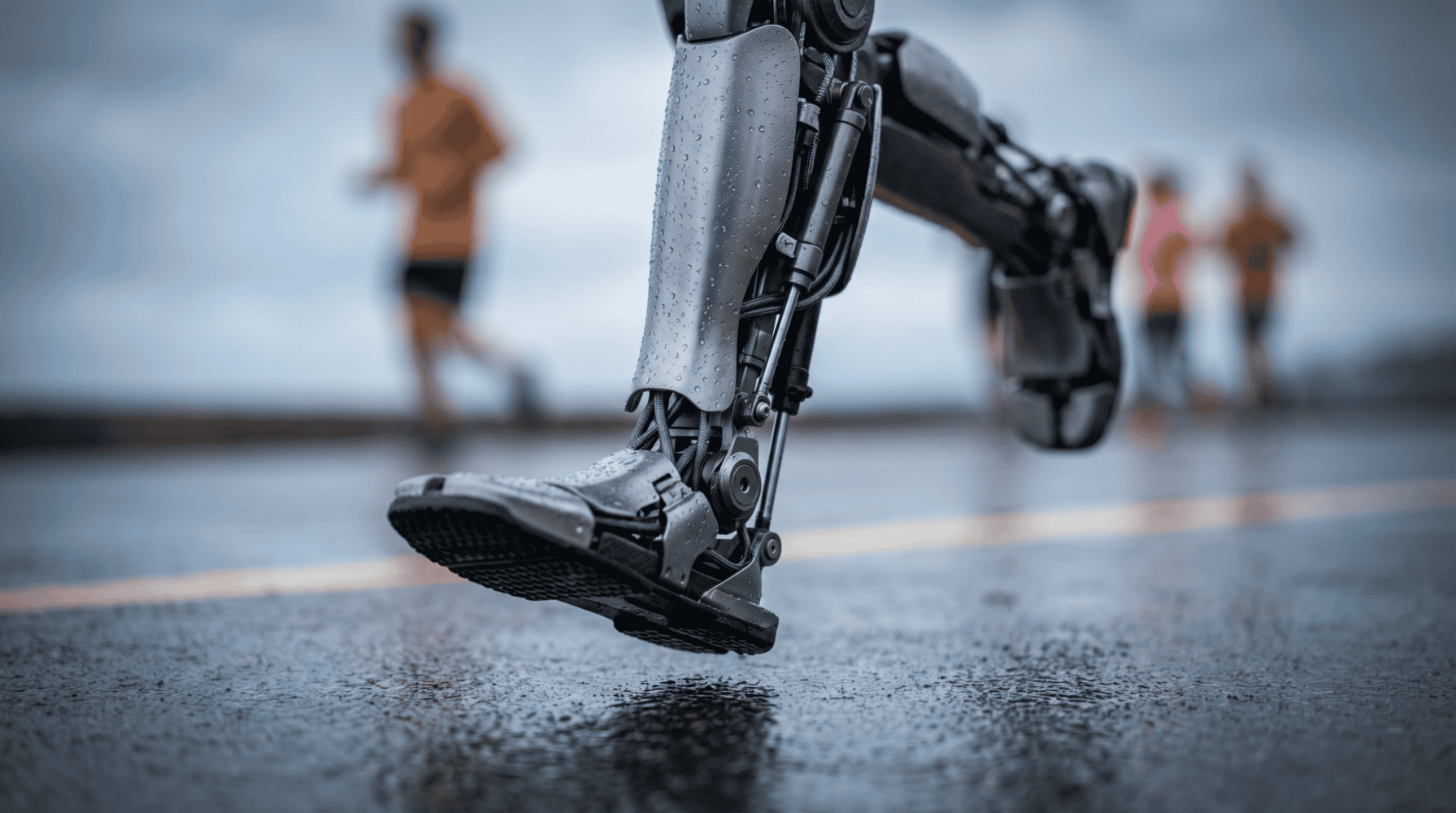

On Sunday, a bipedal humanoid robot completed a half-marathon distance in 50 minutes and 26 seconds. The previous year, the best robot time at the same event was 2 hours, 40 minutes, and 42 seconds. The improvement factor is approximately 3.2x in twelve months. In engineering terms, this is remarkable. In deployment terms, it requires substantial qualification.
What the data shows
The winning robot, designated Lightning, was developed by Honor, a Chinese smartphone manufacturer. It stood 169 centimetres tall with legs of approximately 95 centimetres, designed to replicate the proportions of elite human distance runners. It used a proprietary liquid-cooling system to manage heat dissipation during sustained exertion. It navigated the course autonomously.
Honor swept the top three positions. A second Honor robot reportedly completed the course in 48 minutes and 19 seconds but was classified differently due to competition rules distinguishing autonomous and remote-controlled categories. The participation field expanded from 21 robots in 2025 to over 100 teams in 2026.
The failure rate, however, remains instructive. One robot fell approximately sixty metres from the starting line. Another completed the race with its upper body held together by packing tape. Technicians followed the robots in golf carts equipped with stretchers and wheelchairs. The gap between the best performers and the field average was enormous.
A threefold improvement in speed over twelve months is an engineering achievement. It is not evidence of commercial readiness, and the distance between the two is where most of the capital risk sits.
What the data does not show
The half-marathon is a single-axis test: sustained bipedal locomotion over a fixed distance on a flat, unobstructed, prepared surface. It does not test manipulation, obstacle negotiation, unstructured-environment navigation, human interaction, multi-task switching, or any of the capabilities that would be required for the commercial applications — elderly care, electrical grid maintenance, warehouse logistics, domestic assistance — that are routinely cited as the market justification for humanoid robots.
Alan Fern, a robotics professor at Oregon State University, noted that the results, while impressive, still reflect performance in a highly constrained environment. The gap between a robot running on a prepared road with a support team trailing behind it and a robot operating autonomously in an unstructured environment is not a gap that speed improvements close. It is a qualitatively different engineering problem.
This distinction matters because the capital being allocated to humanoid robotics is being justified on the basis of general-purpose deployment, not half-marathon times. The humanoid robotics market is projected to reach one billion machines by 2050, according to several industry forecasts. That projection assumes machines that can perform useful work in varied environments — not machines that can run fast on flat roads.
The strategic context
The Beijing event took place within a specific geopolitical frame. China’s 2026–2030 five-year plan explicitly names humanoid robot development as a strategic technology priority. The plan sits alongside commitments to brain-computer interfaces, quantum computing, and AI-powered manufacturing. Omdia, a London-based research group, recently ranked three Chinese companies as the only first-tier global vendors in general-purpose embodied robots, based on shipment volumes.
The United States, by contrast, has not produced a comparable centrally directed humanoid robotics programme. Boston Dynamics, historically the most visible American humanoid robotics firm, has moved toward commercial quadrupeds rather than bipedal humanoids. Tesla’s Optimus programme has demonstrated warehouse picking tasks but has not entered competitive locomotion benchmarks.
The framing of the Beijing half-marathon as a US–China technology race is therefore partly accurate: China is investing heavily and demonstrating rapid improvement. But the framing elides the question of what the investment is purchasing. Speed in a half-marathon and utility in an elderly care facility are different products of different engineering programmes.
The question is not how fast the robot ran. The question is what it can do when it stops running.
The honest assessment
The Beijing half-marathon demonstrated three things clearly. First, bipedal locomotion engineering has improved dramatically, driven by advances in motor design, power management, and control algorithms. Second, China’s state-directed investment in humanoid robotics is producing measurable results at a pace that exceeds most external projections. Third, the gap between demonstration capability and deployable capability remains very large, and the event’s own failure data — robots taped together, carried on stretchers, falling at the starting line — makes this visible to anyone willing to look past the headline.
The concentrated view: a robot ran fast. The engineering behind it is genuinely impressive. The claims being attached to it — about commercial readiness, strategic dominance, and the approaching era of humanoid labour — are running considerably ahead of the evidence.