


For three decades, longevity science pursued molecular defects. The emerging systems biology consensus holds a different premise: the body does not break down independently. It loses the capacity to coordinate.
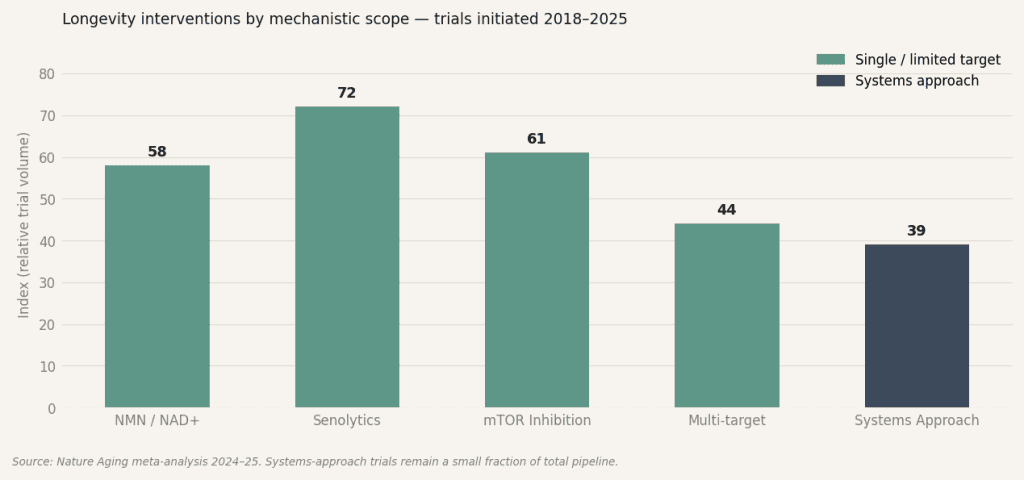
The World Congress on Targeting Longevity convened in Berlin in April 2026 with a reframe that has not yet reached public discourse. The dominant model — damage accumulation — produced genuine results. It also produced a field of increasingly precise interventions targeting increasingly narrow mechanisms, none of which has moved the needle on overall lifespan at population scale.
The emerging alternative is a systems biology model. Ageing, under this view, is not primarily a matter of damage accumulating in individual cells or tissues. It is a progressive failure of communication between biological systems — mitochondria, microbiota, the immune system, the genome — that, when functioning, maintain the organism’s coherent response to time. These systems are not failing independently. They are failing to talk to each other.
The practical implication, if the model holds, is structural. A single-target intervention — however well-designed — cannot restore a conversation. It can, at best, correct one party’s signal. The question changes from what do we fix? to how do we restore the dialogue between systems? That is a different research programme, a different clinical architecture, and a different commercial thesis.
What the industry built, and what it cannot fix
The longevity industry has been built, almost entirely, on the damage model. Altos Labs launched in 2022 with approximately $3 billion in backing, with its primary thesis centred on cellular rejuvenation through reprogramming — a single-mechanism bet. NewLimit, backed by Brian Armstrong, raised $130 million in a 2025 Series B for epigenetic reprogramming research. The Global Wellness Institute projects the longevity market at over $600 billion by 2030, the overwhelming majority of which is structured around individual interventions: supplements, therapies, diagnostics.
The popular face of this approach — the Bryan Johnson / Project Blueprint paradigm — is its most visible expression. The logic is straightforward: identify biomarkers of ageing, target them precisely, measure the result. The framework is coherent. The limitation is that it was built for a model of ageing that the systems biology literature is now challenging on empirical grounds.
The coordination model: what the evidence shows
The 2026 Targeting Longevity Congress proceedings, led by Dr. Marvin Edeas and colleagues at the World Mitochondria Society and International Society of Microbiota, document a consistent finding across several lines of research: age-associated decline correlates more strongly with disruption of inter-system signalling than with the accumulation of damage within individual systems.
Mitochondrial signalling to the genome — a process that declines markedly with age — appears to be central to the maintenance of metabolic coherence. Microbiota-brain interactions, which regulate immune function and neurological repair, show similar patterns of disruption that precede, rather than follow, the tissue damage that single-target interventions attempt to correct.
The implication is not that existing research is wrong. The damage model identified real targets. The problem is that it has been asking a subtly different question than the one that matters. Correcting a single signal in a degraded communication system may produce local improvement while leaving the systemic failure intact.
“The longevity industry has optimised for measurability over mechanism. That is not a scientific failure. It is a research strategy — and it may now require revision.”
What the reframe demands
If the systems model is correct, the research architecture shifts in three directions. First, multi-target combination interventions become the relevant unit of analysis, not single-mechanism compounds. Second, biomarkers of systemic coordination — not just individual tissue health — become the relevant outcome variables. Third, the regulatory and clinical infrastructure for assessing combination interventions, which is not built for systems-level claims, requires substantial revision.
None of this invalidates the substantial body of longevity research conducted under the damage model. It reframes what that research is evidence of — useful partial signals within a larger system that has not yet been adequately mapped. That is a humbler and more accurate description of where the field stands in April 2026.
SOURCES
— Targeting Longevity 2026 Congress — Berlin, April 8–9
— EurekAlert — Targeting Longevity 2026 press release, Feb 2026
— Nature Aging / Cell Metabolism / Aging Cell — systems biology of ageing literature 2024–25
— Global Wellness Institute — longevity market projections
— Altos Labs
— NewLimit